Headline capitalization rules, explained
Title case, sentence case, and the four style guides that disagree with each other. Pick one, apply it everywhere, stop thinking about it.
100OUT OF 100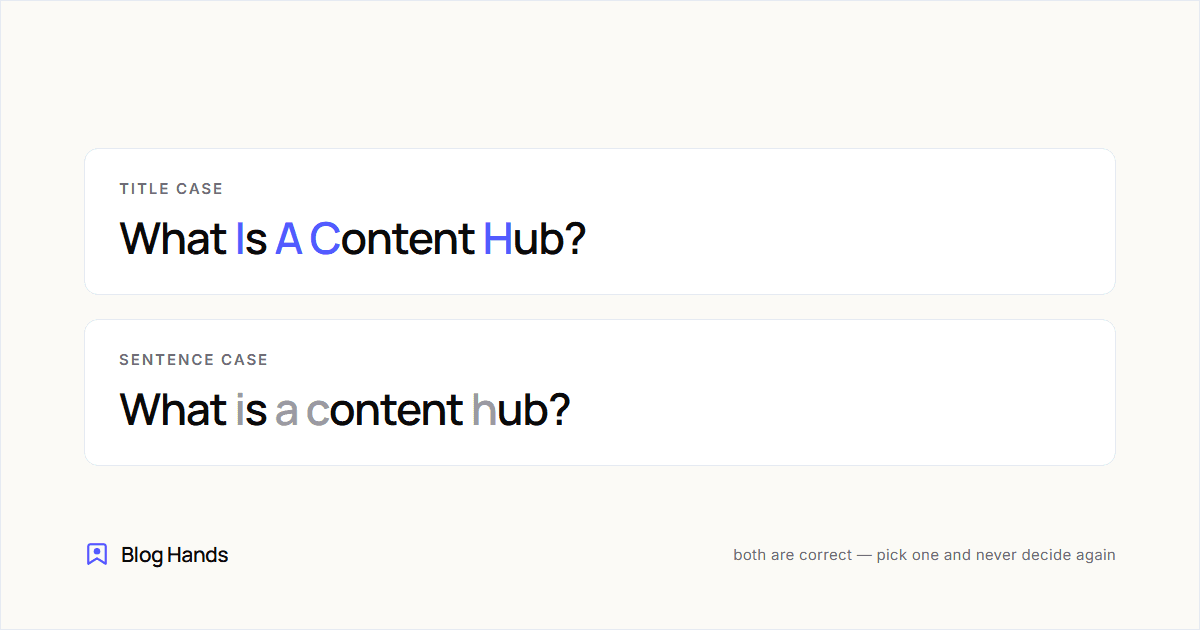
Headline capitalization looks like a trivial question until you have written a hundred headlines and half of them do not match.
It matters for one reason: consistency. A blog where some titles are Title Case and some are sentence case looks unfinished, and readers notice even when they cannot name what is wrong.
Here are the actual rules, the places the style guides disagree, and a way to stop deciding case by case.
Short answer
There are two real choices: title case (Capitalize The Main Words) or sentence case (Capitalize only the first word and proper nouns). Sentence case is easier to apply consistently and reads more naturally on the web. Pick one, write it down, and use it for every headline on the site.
The two styles
Title case capitalizes the important words:
> How to Write a Blog Post That People Finish
Sentence case capitalizes the first word and proper nouns only:
> How to write a blog post that people finish
Both are correct. Neither one ranks better. What matters is that you use the same one every time.
What title case actually capitalizes
The shared rules, which every style guide agrees on:
- Capitalize the first and last word, always, even if it is "a" or "of".
- Capitalize nouns, pronouns, verbs, adjectives, and adverbs.
- Lowercase articles: a, an, the.
- Lowercase short conjunctions: and, but, or, nor, for, yet, so.
- Capitalize both parts of a hyphenated compound in most guides: Well-Known, not Well-known.
So far so simple. The disagreements start with prepositions.
Where the style guides disagree
| Guide | Prepositions | "Is" and "Be" | Common in |
|---|---|---|---|
| AP | Lowercase under 4 letters | Capitalized | News, PR |
| Chicago | Lowercase all, regardless of length | Capitalized | Books, long-form |
| APA | Lowercase under 4 letters | Capitalized | Academic |
| MLA | Lowercase all | Capitalized | Academic |
Each guide publishes its own rules: the AP Stylebook, the Chicago Manual of Style, and the APA style site. Merriam-Webster has a readable summary of where they part company.
The practical effect:
- AP (lowercases prepositions under 4 letters): *How to Write a Blog Post About Anything*
- Chicago: *How to Write a Blog Post about Anything*
Both are right, under their own rules. This is exactly why arguing about it is a waste of an afternoon.
One rule everyone shares that people still get wrong: "is" is a verb, so it is capitalized. What Is a Content Hub, not What is a Content Hub. It looks short, so people lowercase it out of habit.
Which one should my type of site use?
The choice usually follows the category you are in, because readers arrive with expectations already set by everyone else in that category.
| Kind of site | Usually picks | Why |
|---|---|---|
| News, magazines, editorial publishers | Title case | Readers expect a newsstand look, and AP is already the newsroom default |
| Law firms, medical practices, financial advisors | Title case | The formality reads as care, and these audiences notice a casual register |
| Universities and journals | Title case | APA and MLA are already in use elsewhere on the site |
| SaaS and software products | Sentence case | The product interface is already sentence case, so the blog matches the app |
| Ecommerce and DTC brands | Sentence case | Headlines sit beside product copy and need to read conversationally |
| Agencies, consultants, personal blogs, newsletters | Sentence case | It sounds like a person talking, which is usually the point |
| Government and public services | Sentence case | Plain-language standards push toward it, and it is easier for a large team to apply consistently |
Two warnings about that table. It describes what is common, not what is required, and a real brand can sit against its category on purpose. A law firm that wants to read as approachable rather than austere is making a deliberate choice, not a mistake.
The second warning matters more. Category is a tiebreaker, not the decision. If you already have 200 published posts in title case, staying in title case beats being theoretically right, because a half-converted blog looks worse than either style applied consistently. Converting an archive is a real project, so only start it if you are going to finish it.
If you are genuinely stuck, the useful question is not "which is correct." It is: does this site want to sound like a publication, or like a person? Publications lean title case. People lean sentence case.
Why we recommend sentence case
3 reasons, none of them about search rankings:
It is harder to get wrong. There is one rule. No preposition-length tables, no guide to memorize. A writer with no style training will produce a correct headline on the first try.
It reads faster. Title Case Puts A Small Speed Bump Before Every Word. Sentence case reads at the speed of ordinary prose, which is what a scanning reader needs.
It survives being quoted. When your headline appears in a search result, a social card, or an AI answer, sentence case looks like a sentence. Title case can look like a headline that has been pasted somewhere it does not belong.
There is a real trade-off, though, and it is worth naming. Sentence case can look under-dressed in a formal or editorial context, and a headline full of proper nouns ends up looking inconsistent anyway. If your brand reads as a magazine rather than a product, title case is the better fit. The caveat applies to us too: we use sentence case, but we would not tell a law firm or a medical journal to switch.
Choose deliberately rather than by accident.
Things that break the rule
Whatever you pick, these override it:
- Proper nouns stay capitalized: Google, Chicago, Blog Hands.
- Brand styling stays as the brand writes it: iPhone, eBay, danceLoud.
- Acronyms stay uppercase: SEO, CRM, B2B.
- The first word after a colon is capitalized in most guides, in both styles.
That last one catches people. In sentence case: Content hubs: Why one topic beats twenty scattered posts.
Practical rules that matter more than case
Case is the easy part. These affect whether the headline works:
Keep it under about 60 characters if you want the whole thing visible in a search result. Google truncates by width, at roughly 600 pixels, so the count is a guide rather than a hard cut. Longer titles get cut off, and the cut usually lands somewhere unhelpful.
Put the real subject early. Search results and social feeds truncate the end. "Blog post length: what the data says" survives truncation. "What the data actually says about the correct length of a blog post" does not.
Match the headline to the content. A title that overpromises gets clicks and then loses trust. Both matter.
Avoid ALL CAPS. Some screen readers read capitalized words letter by letter, and it reads as shouting to everyone else. The W3C's guidance on text style covers why.
How to stop deciding every time
Write your choice down in one line and put it where writers will see it:
> All headlines and H2s use sentence case. Proper nouns and acronyms keep their capitals.
That is the whole style guide. It takes 10 seconds to check against, and it removes the decision from every future post.
If you are running a blog with several writers, put it in the brief template rather than hoping people remember.
Tools
Free converters will apply AP, Chicago, APA, or MLA rules for you. Search "title case converter" and several will come up. They are useful for a one-off check.
For an existing blog, the more valuable check is consistency across posts rather than correctness of any single one. Our Blog Grader looks at the title alongside the rest of the post: whether it matches the content, whether it survives truncation, whether the H1 and the meta title agree.
Frequently asked
- Should blog titles be title case or sentence case?
- Either is correct. Sentence case is easier to apply consistently and reads faster on screen; title case feels more formal. What matters is picking one and using it for every headline.
- Which types of businesses use title case?
- Title case is most common on news sites, magazines, universities, journals, law firms, medical practices and financial advisors, where a formal register is expected. Sentence case is more common on SaaS products, ecommerce brands, agencies, personal blogs and government sites. Category is a tiebreaker, not a rule.
- Is "is" capitalized in a title?
- Yes. "Is" is a verb, so every major style guide capitalizes it in title case: "What Is a Content Hub", not "What is a Content Hub". Its short length makes people lowercase it by mistake.
- Are prepositions capitalized in titles?
- It depends on the guide. AP and APA capitalize prepositions of four letters or more; Chicago and MLA lowercase all of them regardless of length. Both are correct within their own rules.
- Does headline capitalization affect SEO?
- No. Search engines do not rank title case above sentence case. Title length and how well the headline matches the content do matter.
Pick a style. Write it in one sentence. Apply it everywhere.
The consistency is worth something. The specific choice is not worth a meeting.