How Google search works, in simple terms
Crawling, indexing, ranking, and the answer layer on top of all three. Explained without the jargon, and with what actually changed.
100OUT OF 100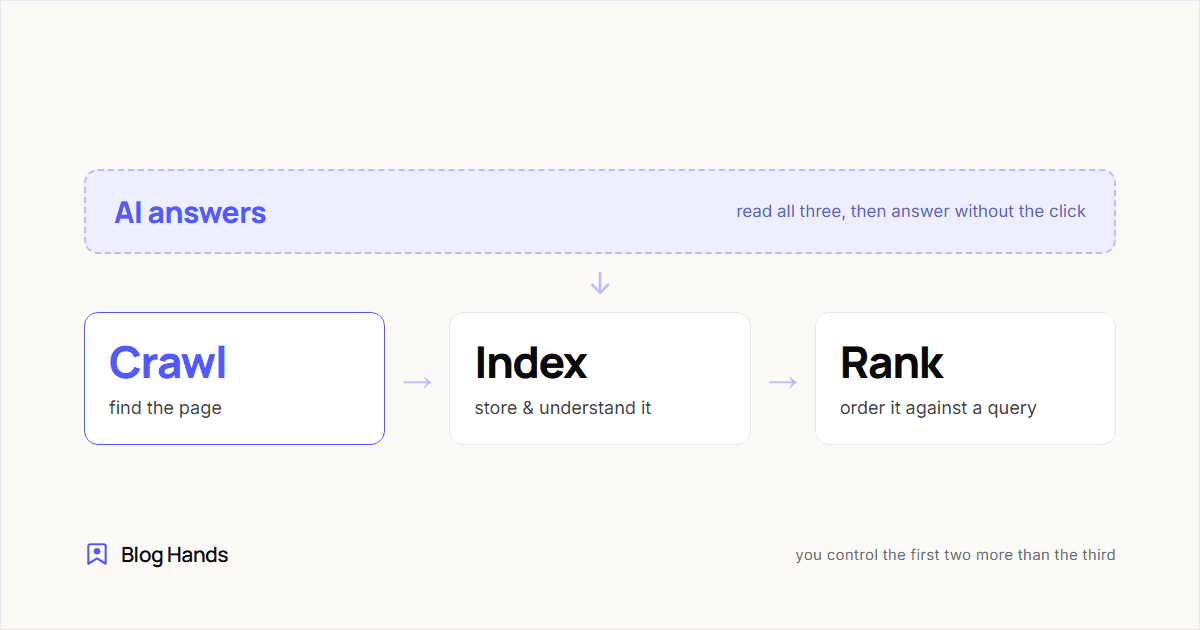
Most explanations of Google's algorithm are either a list of two hundred "ranking factors" or a shrug.
The useful version is smaller than that. Google runs 3 processes, and a 4th layer now sits on top. Understanding those 4 tells you most of what you can actually act on.
Google publishes its own plain explanation at How Search Works, and the technical detail lives in Search Central. This is the short version, plus what changed.
Short answer
Google does three things: it crawls the web to find pages, it indexes what it finds, and it ranks the index against your query. A generated answer now often sits on top of those results. You cannot control the ranking, but you can control whether a page is crawlable, whether it clearly answers a real question, and whether it is quotable.
The three processes
1. Crawling: finding pages
Google runs software that follows links around the web, reading pages and following the links on them to more pages. That is crawling, and the software is called Googlebot.
It finds your pages 3 ways: a link from a page it already knows, your sitemap, or a direct submission in Search Console.
What can stop it:
- A `robots.txt` rule that blocks the path.
- A `noindex` tag on the page.
- No links pointing to the page from anywhere. That is an "orphan" page.
- Content that only appears after a login.
This is the layer where most self-inflicted damage happens, and it is the easiest to check. Google's crawling and indexing documentation lists every directive that can block a page, and Search Console will tell you which of your pages it actually reached.
2. Indexing: storing and understanding
Once Google has the page, it works out what the page is about and files it. Not everything crawled gets indexed. Google routinely skips pages it judges to be duplicates, thin, or not worth storing.
The signals that matter here are unglamorous: a clear title, a heading structure that reflects the actual content, text that is present in the HTML rather than assembled later by scripts, and a canonical tag when the same content exists at more than one URL.
3. Ranking: ordering the results
When someone searches, Google pulls matching pages from the index and orders them. This is the part with the mythology.
The honest summary of what it weighs:
- Relevance. Does the page address what was actually asked?
- Quality. Is there evidence this source knows the subject? Links from other sites are still a large part of this.
- Usability. Does the page load, work on a phone, and not fight the reader?
- Context. Where is the searcher, what language, what have similar searchers found useful?
Nobody outside Google has the weights, they change constantly, and they differ by query type. Anyone quoting you an exact ranking formula is guessing.
The fourth layer: generated answers
The newer part, and the one that changed the shape of the job.
For many queries Google now writes an answer at the top of the page, assembled from sources it selects. Assistants like ChatGPT do something similar without a result page at all.
2 consequences that are worth planning around:
Impressions can rise while clicks fall. Your page is being used as a source, but the reader gets the answer without visiting. This shows up in Search Console as a falling click-through rate on a page that has not moved in the rankings.
Being quotable became a goal in itself. Content that gets pulled into answers tends to be structured in self-contained chunks: a clear question as a heading, a direct answer immediately under it, specific facts rather than general encouragement.
This is the same discipline that used to win featured snippets, which is convenient. The old advice still applies.
What actually earns an answer box
Answer boxes (the short extract Google lifts to the top of the results) go to pages that make extraction easy.
The pattern that works:
- Use the actual question as a heading, phrased the way people search it.
- Answer it in the first 2 or 3 sentences underneath. No warm-up.
- Then expand.
If the question has a list answer, use a real list. If it is a comparison, use a real table. Google lifts the structure as well as the words.
The thing people get wrong is burying the answer. A section headed "What is a content hub?" that opens with three sentences about why content hubs matter has given the extractor nothing to take.
Search intent, briefly
Before writing anything, work out which of 4 things the searcher wants:
- Informational. They want to know something. "how google search works"
- Navigational. They want a specific site. "search console login"
- Commercial. They are comparing before buying. "best blog writing service"
- Transactional. They are ready to act. "hire blog writer"
The fastest way to check is to run the search and look. Google has already decided what the query means, and the result page shows you the decision. If the first page is all product listings, an explainer will not rank there no matter how good it is.
Mismatched intent is the most common reason we see for a well-written post never ranking. The writing is fine. It is answering a question the search result was not asking.
Following algorithm updates without losing your week
Google changes the ranking systems constantly, and announces the larger ones as "core updates." An update rolls out over 2 days to 3 weeks, results move around while it settles, and commentary appears immediately.
A sane routine:
Watch your own data first. Search Console tells you what happened to your site. Industry commentary tells you what happened to somebody else's.
Wait for the rollout to finish before concluding anything. Movement mid-update is often noise.
Check whether the drop is even. A sitewide fall suggests a technical or quality problem. A fall on one section suggests that section's topic got reassessed.
Do not chase the recovery tactic of the week. Google's own guidance after core updates has been consistent for years. Its core updates page says to ask whether the page genuinely serves the person reading it, and lists the questions to ask. Unsatisfying, and still the correct answer.
The one thing worth doing on a schedule is checking Search Console monthly for pages whose impressions hold steady while clicks fall. That is the modern failure mode, and it is invisible if you only watch total traffic.
What you control
Short list. It is the same list it has been for years, with one addition.
- Crawlable and indexable. No accidental blocks, real links to every page you care about, a current sitemap.
- One clear job per page. One main question, answered properly.
- Structure that mirrors the content. Headings that are real headings, lists that are real lists.
- Evidence you know the subject. Specific detail, real examples, first-hand experience.
- Quotable chunks. (the addition) Question, then answer, then expansion.
Everything else is either downstream of those or outside your control.
Frequently asked
- How does Google decide what ranks first?
- It weighs relevance to the query, evidence of quality and expertise, page usability, and the searcher's context. The exact weighting is not public, changes constantly, and varies by query type.
- Why are my impressions up but my clicks down?
- Usually because a generated answer at the top of the results is satisfying the query without a click. Your page may still be a source. Check Search Console for a falling click-through rate on pages holding steady positions.
- How do I get into a Google answer box?
- Use the question as a heading, answer it directly in the first two or three sentences beneath, then expand. Use real lists and tables where the answer has that shape, because the extractor lifts structure as well as text.
- What should I do after a Google core update?
- Wait for the rollout to finish, then check whether the drop is sitewide or limited to one section. Sitewide suggests a technical or quality issue; a single section suggests that topic was reassessed. Avoid reacting mid-rollout.
- What is search intent?
- What the searcher actually wants: information, a specific site, a comparison before buying, or to act now. Run the search and look at the results. Google has already decided, and the page shows you its decision.
Google finds pages, files them, ranks them, and now often summarises them. You cannot control the ranking. You can control whether a page is findable, whether it answers one real question properly, and whether it is easy to quote.
That has not changed much. The answer layer just raised the cost of writing something vague.