Blog writing questions and answers
The questions people actually ask us before they start a blog, answered plainly, with no upsell attached.
100OUT OF 100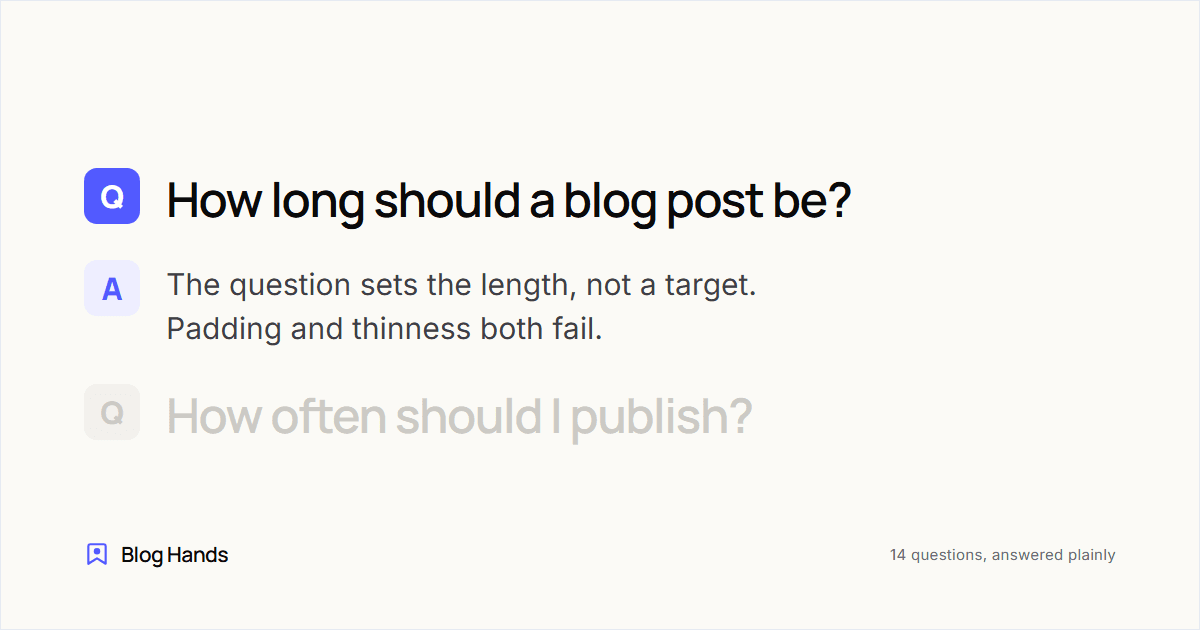
We have been shipping blog posts since 2012. In that time the same questions come up over and over. From founders, from marketing managers, from people who inherited a neglected blog and do not know where to start.
This is our answer sheet. No theory. Just what we tell people when they ask.
Short answer
Most blogging questions come down to three things: publish on a schedule you can keep, write about what your customers ask you, and give every post one clear job. Everything else is detail.
How long should a blog post be?
There is no correct number. The question sets the length, not a target you pick first.
Answering the question is the floor, not the ceiling. That distinction matters, because "just answer the question" gets misread as permission to publish 300 words and move on. A reader who gets a one-line answer still has three follow-up questions, and they will go somewhere else to get them.
So a finished post does two jobs. It answers the question up front, in the first paragraph, where nobody has to hunt for it. Then it covers what that answer raises: the exceptions, the how, the "what if my situation is different." When you genuinely run out of follow-ups, you are done.
The pages already ranking are a useful reference point, not a rule. If the top results are 600-word answers, that tells you people searching this topic want a quick answer. If they are 2,000-word guides, the topic has more surface than you might have assumed. Use it as a sanity check, then ignore it when you have a reason to. A shorter post beats a longer one when it is clearer. A longer one wins when the extra length is substance and not warm-up.
There are two failure modes, and only one of them gets talked about. Padding is the loud one: someone reads that "long-form performs better," writes 2,000 words where 900 would do, and buries the answer under warm-up paragraphs. Thinness is the quiet one: a post that technically answers the question and gives the reader no reason to stay. Google's helpful content guidance asks whether a page leaves someone feeling they have to search again. Both failures fail that test.
So the honest answer is that it depends on the topic, and anyone handing you a fixed number is guessing about a topic they have not seen. Two things do not depend on anything. The post has to answer the question. And it has to cover the topic properly, so the reader is actually finished when they get to the end. Word count is what falls out of doing those two things. It is not the thing you aim at.
How often should I publish?
Pick a cadence you can hold for a year.
1 post a month, every month, beats 4 posts in January and nothing until June. Consistency does two things: it gives search engines a reason to crawl your site regularly, and it gives you enough posts to learn from.
If you are starting from zero, monthly is fine. If you have a team or a writing partner, weekly is a real advantage. What matters is that the number does not drop to zero in a busy quarter.
What should I write about?
Write down every question a customer has asked you in the last month.
That list is your content plan. It costs nothing, it is specific to your business, and every item on it is a question someone is already typing into a search box.
When that list runs dry, use a research tool to find the adjacent questions. Our Blog Topic Research Tool is free and does not need an account. It pulls real autocomplete queries and groups them into topics.
Do I need to worry about keywords?
Less than you think, but not zero.
The old approach was to pick a keyword and repeat it. That does not work any more and it reads badly. The current approach is to pick a topic and cover it properly: the main question, the follow-up questions, the related terms people naturally use.
If you write a genuinely complete answer, the keywords take care of themselves. What you should still do deliberately:
- Put the main question in your title and your H1.
- Use the words your readers use, not internal jargon.
- Give the post a clear URL slug that matches the topic.
Should I use AI to write my blog?
Yes, with supervision. That is our whole position, and we say it plainly because we sell both.
AI is very good at structure, first drafts, and volume. It is bad at knowing what is actually true about your business, and it defaults to a flat, agreeable voice that reads like every other AI post.
What works: a human decides the angle and supplies the real detail, AI drafts, a human edits for truth and voice. What does not work: a prompt, a paste, and a publish button.
If you want to see what that looks like on your own site, drop your URL and we will write you a real post for free.
How do I know if a post is any good before I publish it?
Read it out loud. If you get bored, cut. A 5 minute read that answers the question beats a 12 minute read that circles it.
For a more structured check, we built the Blog Grader. Paste a URL and it scores the post on the things that actually move it: whether it answers the question early, whether the structure is scannable, whether the title matches the content.
Why isn't my blog getting traffic?
Usually 1 of 4 reasons:
- The posts are too new. New pages routinely take months to rank. Google's own Search Console help is clear that indexing alone can take time, and ranking longer. Patience is part of the strategy.
- Nobody is searching for the topic. Passionate does not mean popular. Check demand before you write.
- The competition is much stronger. If the first page is all major publishers, pick a narrower question.
- There are not enough posts. A blog with five posts has very few chances to be found. Volume, over time, is what compounds.
Should I update old posts or write new ones?
Update first. It is cheaper and it works faster.
A post that already ranks on page two is much closer to page one than a blank page is. Refresh the facts, tighten the opening, add the sections that competitors cover and you do not. Then republish and update the date.
Write new posts to fill genuine gaps, not to hit a number.
Do I need images?
One good image at the top, and a diagram or screenshot anywhere the words get hard to follow.
Skip decorative stock photos of people shaking hands. They add file size and nothing else. If you are explaining a process, draw the process.
How long until blogging works?
Months, not weeks. Often 6 to 12 months before the pattern is clear.
This is the honest answer and it is why a lot of blogs get abandoned. The compounding is real but it is slow at the start. If you need traffic this quarter, blogging is the wrong lever. Buy ads. If you want an asset that keeps earning after you stop paying, this is the one.
Should I write the post or hire someone?
Write it yourself if you have the time and you are the expert. Nothing beats the real thing.
Hire when one of these is true: you keep not doing it, the writing takes you a whole day, or you need more posts than you can personally produce. The cost of an unwritten post is not zero. It is the traffic it never earned.
What makes a Q&A post work?
Since this post is one, it is worth saying.
A good Q&A post uses real questions, in the reader's own words, with the answer immediately underneath. No long preamble. No "great question!" Each answer should stand on its own, because most readers will land on one question and leave.
Use a heading for every question. That way search engines can pull a single answer out and show it directly, and readers can scan to the one they came for.
Where should the call to action go?
At the end, and once in the middle if the post is long.
Match the ask to the reader's stage. Someone reading "how long should a blog post be" is not ready to buy a retainer. Offer them the next useful thing: a tool, a related guide, a free sample.
How do I keep a blog going when I get busy?
Lower the bar and keep the date.
A 600-word post published on schedule is worth more than a 2,000-word post that never ships. Keep a running list of half-formed ideas so you never start from a blank page. And write the post before you design the image. The image is the part people use to procrastinate.
Frequently asked
- How long should a blog post be for SEO?
- Match the length of what already ranks for your topic. Answer the question completely, then stop. Padding a short answer out to hit a word count hurts both readers and rankings.
- How often should a small business publish blog posts?
- Once a month, held for a year, beats a burst of posts followed by silence. Pick the cadence you can sustain when you are busy, not the one you can manage in a good week.
- Is AI-written content bad for SEO?
- Unsupervised AI content is. AI drafting with a human deciding the angle, supplying real detail, and editing for truth and voice is not. Search engines judge the result, not the tool.
- How long does it take for a blog to bring in traffic?
- Usually 6 to 12 months before the pattern is clear. Blogging compounds slowly. If you need traffic this quarter, paid ads are the right lever instead.
If your question is not here, it is probably one we should add. The list grows as people ask.
The short version of all of it: write about what your customers ask, publish on a schedule you can keep, and give each post one job.